Deep Dive
The Origins of Mammals: Life Before Juramaia sinensis
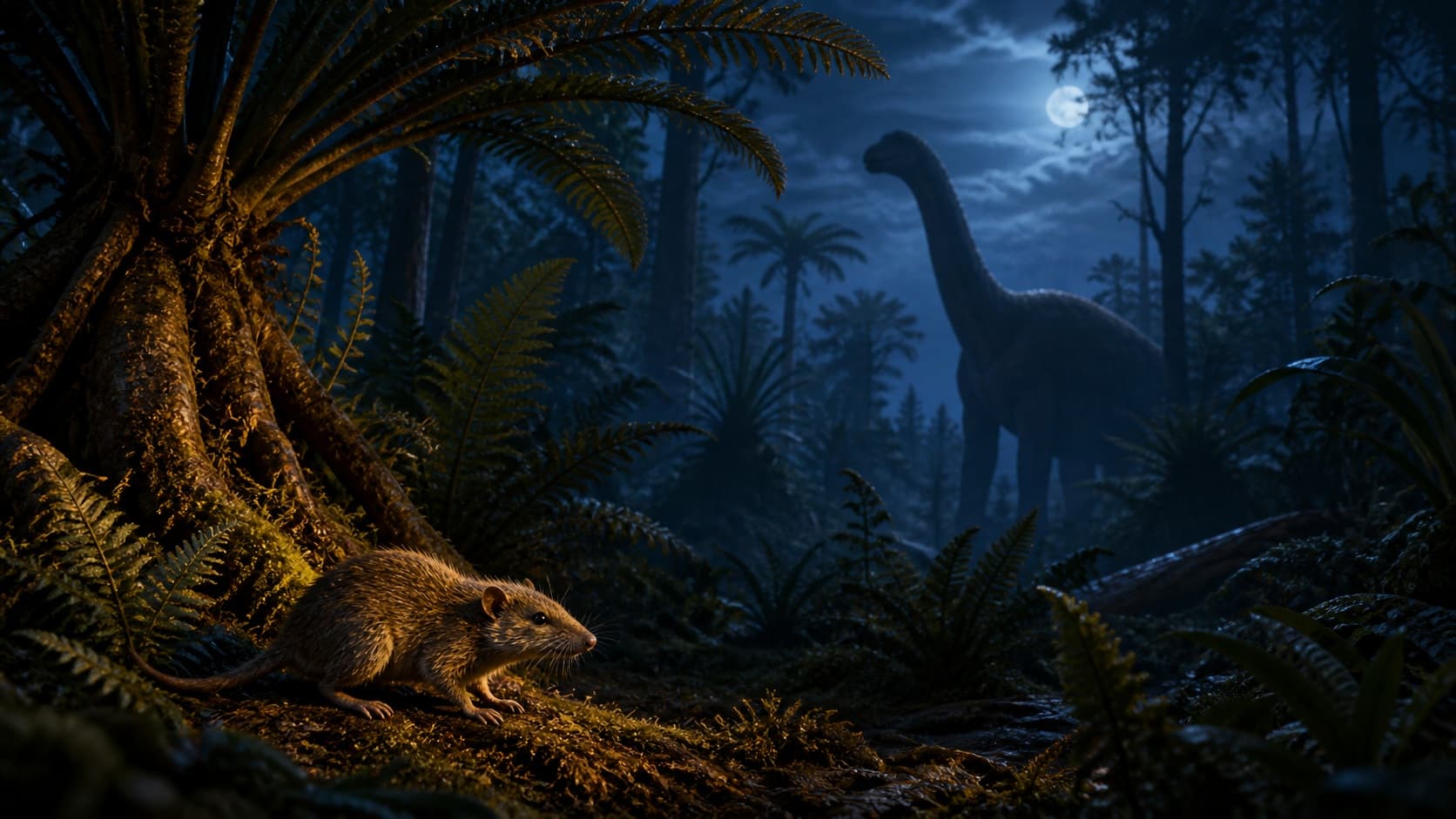
Journey back even further than our timeline's starting point. Discover the synapsid ancestors and early mammals that lived in the shadow of the dinosaurs during the Triassic and Jurassic periods. Learn how tiny, shrew-like creatures developed key mammalian traits—fur, warm-bloodedness, and specialized teeth—long before Juramaia sinensis appeared around 160 million years ago.
The Synapsid Lineage
The story of mammals begins not with mammals themselves, but with synapsids — a group of amniotes that diverged from reptiles more than 300 million years ago during the Carboniferous period. Synapsids are defined by a single temporal fenestra (a hole in the skull behind each eye), which distinguishes them from the diapsids that gave rise to reptiles and birds.
Early synapsids included the sail-backed Dimetrodon and the stocky, pig-like Lystrosaurus. Over tens of millions of years, a lineage of synapsids called cynodonts evolved increasingly mammal-like features: differentiated teeth for cutting and grinding, an upright posture, and evidence of whiskers suggesting hair. By the late Triassic, cynodonts were the ancestors from which the first true mammals would emerge.
Surviving in the Triassic and Jurassic
The Triassic and Jurassic periods were dominated by dinosaurs, yet early mammals not only survived but diversified into a remarkable variety of ecological niches. Fossils reveal swimming, burrowing, gliding, and tree-climbing mammals — far more ecologically diverse than the traditional 'nocturnal insectivore' picture suggests.
Size was a constraint. With dinosaurs filling large-body niches, early mammals were typically small — mouse to rat-sized at most. But smallness had advantages: lower food requirements, easier hiding, and the ability to exploit microhabitats unavailable to large dinosaurs.
The Emergence of Key Mammalian Traits
Several traits distinguish mammals from other vertebrates, and the fossil record allows us to trace when each emerged. The transition from multiple jawbones (as in reptiles) to a single dentary bone — with the former jaw bones repurposed as the middle ear ossicles — is one of the most elegant examples of evolutionary remodeling in the fossil record.
Endothermy (warm-bloodedness), lactation, and hair were all present by the Jurassic. These traits are interconnected: maintaining a stable body temperature requires both insulation (hair) and a reliable food source, which lactation helps provide for vulnerable young.
The Significance of Juramaia sinensis
Juramaia sinensis, discovered in China and dated to approximately 160 million years ago, represents one of the earliest known eutherian mammals — the lineage that would eventually produce placental mammals, including humans. Its discovery pushed back the estimated origin of eutherians by 35 million years.
While Juramaia sinensis is this site's starting point, it is a milestone rather than a true beginning. The innovations that made it possible — and that made us possible — were the product of hundreds of millions of years of earlier vertebrate and synapsid evolution.

AI Assistant
Have a question? Ask Dr. Elena Marsh
Dr. Marsh is an AI-powered expert in human and mammalian evolution, ready to answer your questions about any topic covered on this site.