Ardipithecus ramidus
Ardi / Early hominin
About 4.4 million years ago
Pliocene
Ardipithecus ramidus
Ardi / Early hominin
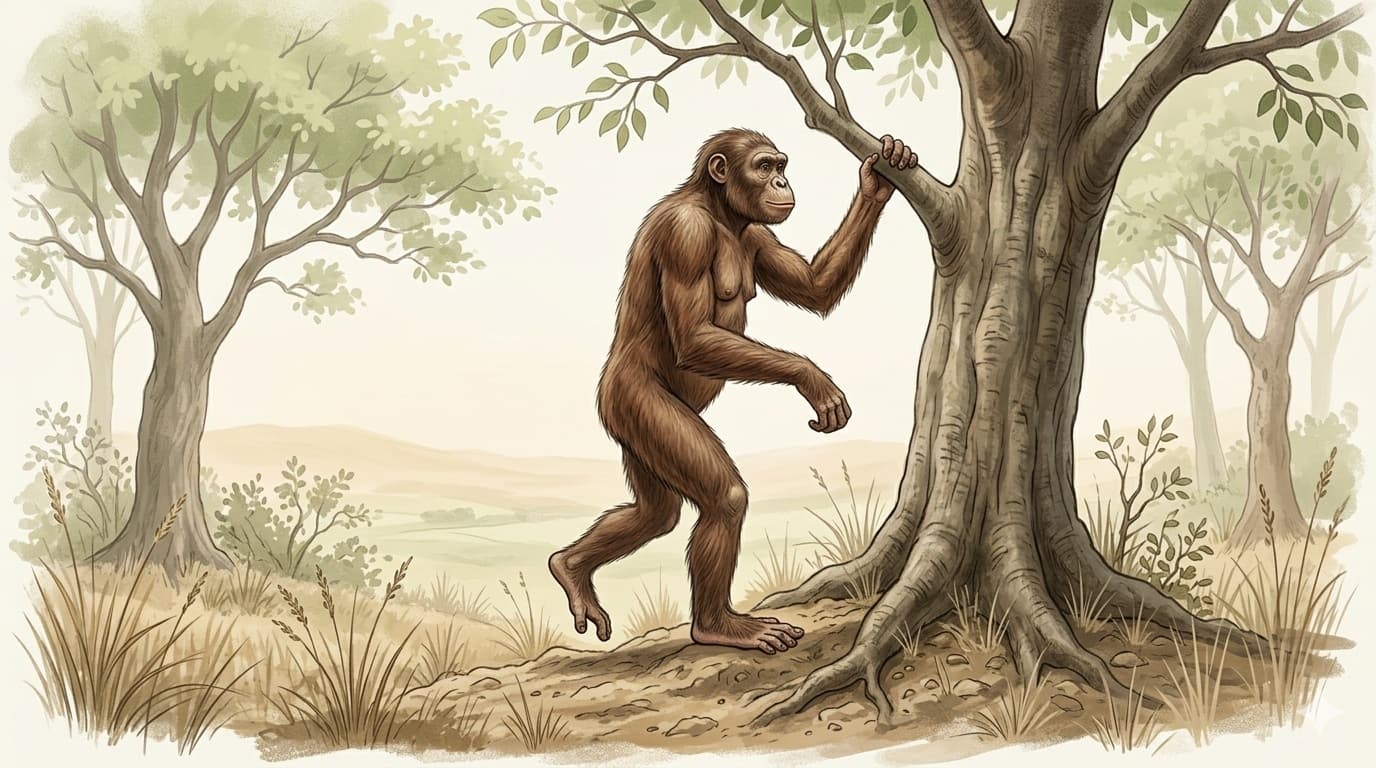
Known informally as 'Ardi,' this early hominin from Ethiopia challenged assumptions about human evolution by combining bipedal walking with tree-climbing adaptations.
Overview
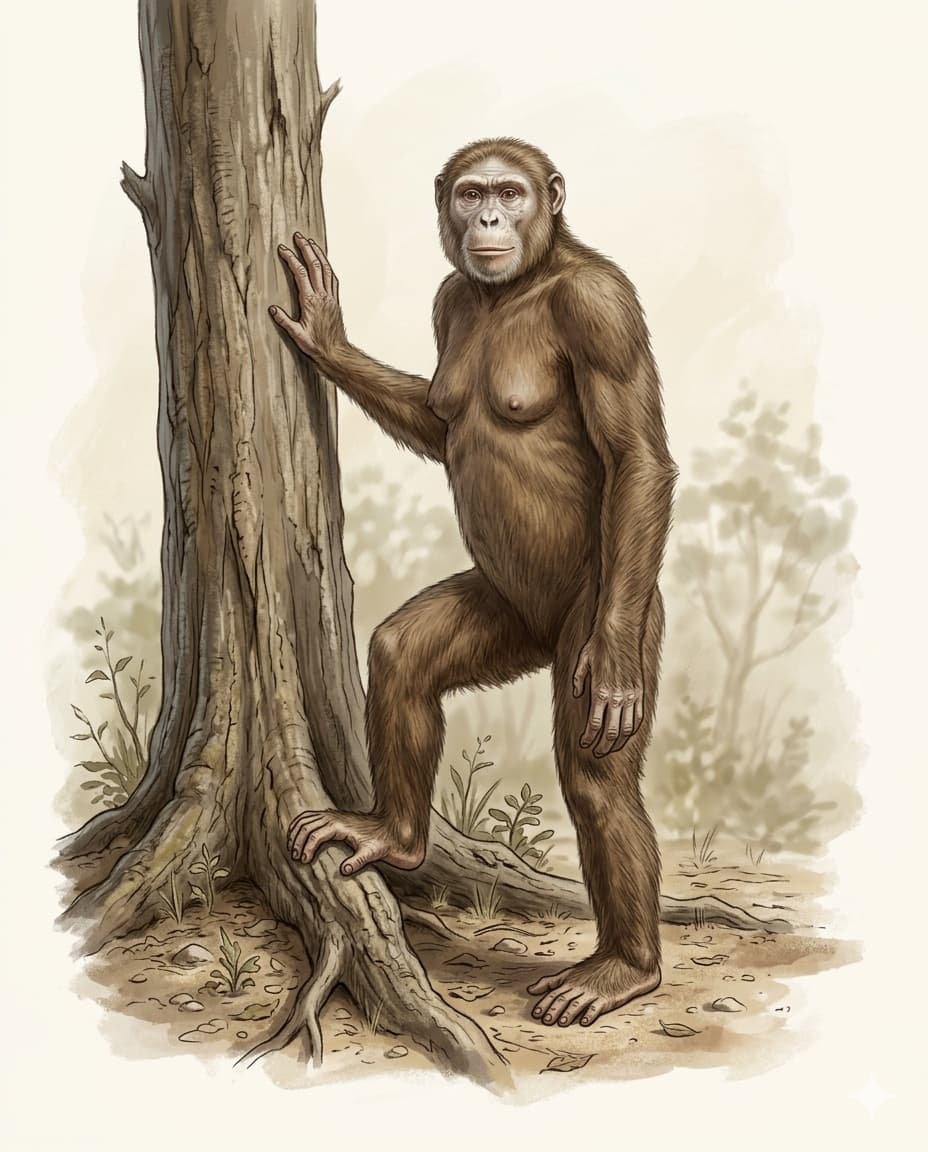
Ardipithecus ramidus, commonly known as 'Ardi,' is one of the most remarkable and complete early hominin fossils ever discovered. Living approximately 4.4 million years ago in what is now the Afar region of Ethiopia, Ardi challenges many long-held assumptions about human evolution. The most complete specimen — a partial skeleton representing about 45% of the skeleton — reveals a mosaic creature: capable of walking upright on the ground while retaining a grasping big toe and flexible foot better suited for climbing trees than later hominins. Ardi's anatomy suggests that the last common ancestor of humans and chimpanzees was not necessarily chimp-like, overturning a simple model in which human evolution involved straightforward departure from a chimpanzee-like ancestor. Ardipithecus ramidus had small canine teeth, a less projecting face, and a brain slightly larger than a chimpanzee's — all pointing toward features that would become more pronounced in the australopithecines and later Homo.
Key Traits
- Body mass estimated around 50 kg (110 lbs) with a height of approximately 120 cm (4 ft)
- Bipedal walking ability, but less efficient than later hominins
- Grasping big toe retained for tree climbing — unlike modern humans
- Reduced canine teeth compared to other apes — important for social evolution
- Brain size approximately 300–350 cc — similar to a chimpanzee
- Thin tooth enamel suggesting a diet of fruit, leaves, and possibly small animals
Habitat
Ardi inhabited a woodland environment in the Afar Triangle of Ethiopia — not the open savanna once assumed as the birthplace of bipedalism. The landscape included patches of woodland, shrubs, and grassland near rivers and lakes.
Diet
Omnivorous, likely consuming fruits, leaves, seeds, roots, and possibly small vertebrates and invertebrates. The thin enamel on its teeth suggests softer foods than those consumed by later australopithecines.
Why This Stage Matters
The discovery and analysis of Ardipithecus ramidus, published in a landmark 2009 set of papers in Science, fundamentally revised models of early hominin evolution. It demonstrated that the woodland hypothesis for bipedalism had merit and that the human lineage did not simply walk out of the forest and onto the savanna in one step.
Evolutionary Context
Ardipithecus ramidus is positioned in the evolutionary sequence between the earliest potential hominins (such as Sahelanthropus and Orrorin) and the well-known australopithecines. It fills a critical gap, showing that the transition toward fully committed bipedalism was gradual and that early hominins retained significant arboreal adaptations long after walking upright had begun.
What Came Before & After


Key Sources
- White, T. D., et al. (2009). Ardipithecus ramidus and the paleobiology of early hominids. Science, 326, 75–86.
- Lovejoy, C. O. (2009). Reexamining human origins in light of Ardipithecus ramidus. Science, 326, 74.
Want to learn more?
Ask Dr. Elena Marsh
Have a question about Ardipithecus ramidus or where it fits in the story of human evolution? Our AI expert is ready to help.
 Ask Dr. Elena Marsh