Australopithecus afarensis
Lucy's species
About 3.9 million years ago
Pliocene
Australopithecus afarensis
Lucy's species
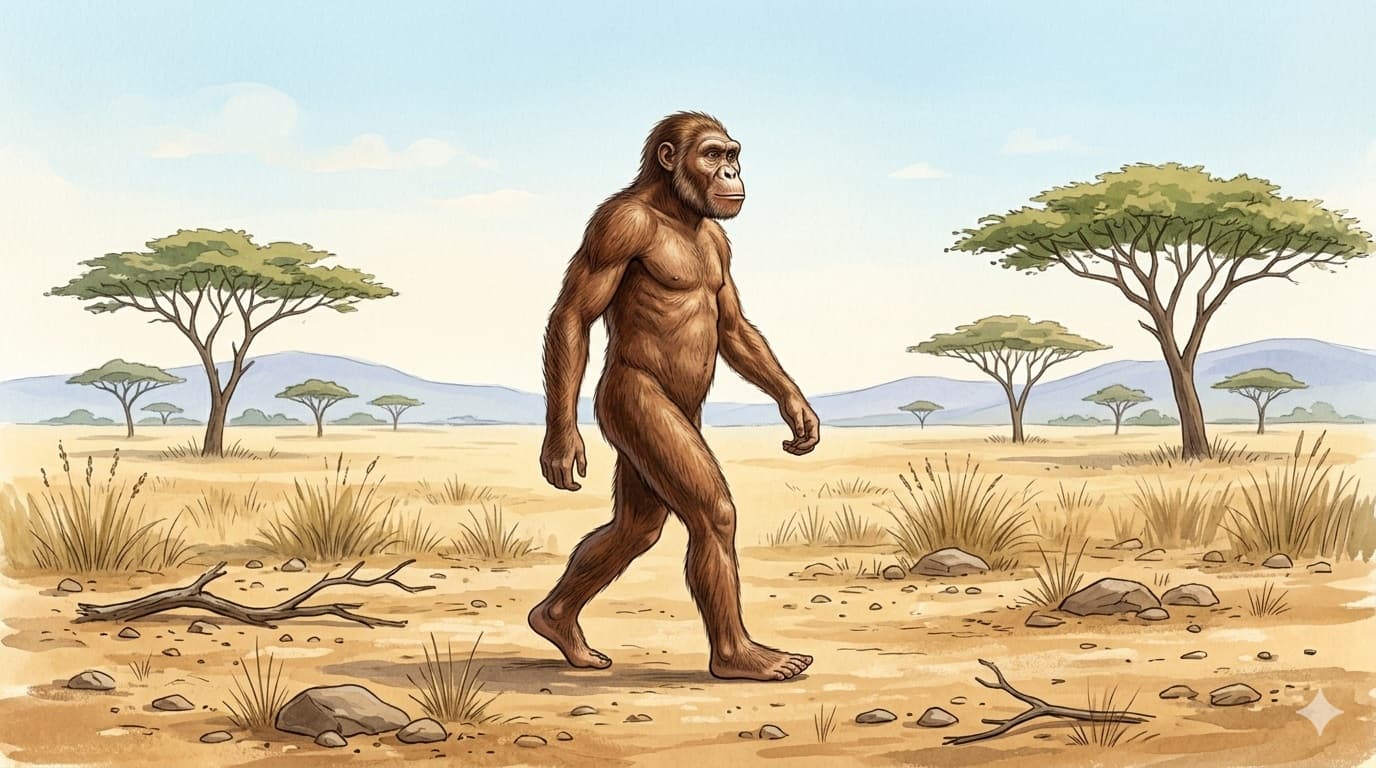
Famous as 'Lucy's species,' Australopithecus afarensis was a committed biped with a small brain that thrived for over a million years in East Africa.
Overview
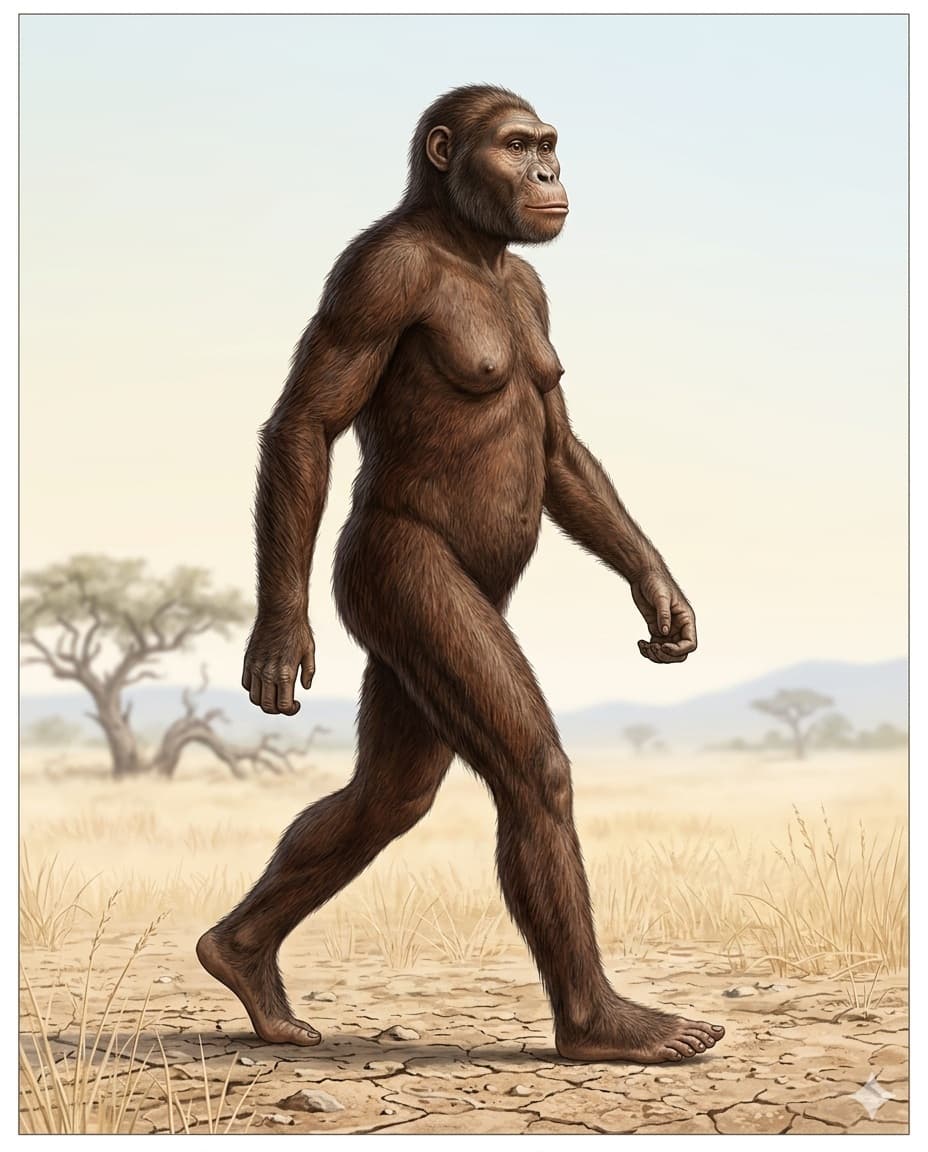
Australopithecus afarensis is one of the most iconic and well-studied hominins in the fossil record, best known through the famous 'Lucy' skeleton discovered in 1974 in the Afar region of Ethiopia. This species lived from approximately 3.9 to 2.9 million years ago across East Africa — an extraordinarily long span for a single hominin species. A. afarensis was fully bipedal, walking upright on two legs as evidenced by the Laetoli footprints from Tanzania, preserved in volcanic ash 3.6 million years ago. Yet it retained a small, ape-sized brain (approximately 380–430 cc) and long arms relative to its body, suggesting it still spent time in trees. The combination of upright walking and small brain was revolutionary for our understanding of human evolution: it confirmed that bipedalism preceded significant brain enlargement by millions of years, upending older assumptions that big brains and walking evolved together.
Key Traits
- Fully bipedal — the Laetoli footprints provide direct evidence of upright walking
- Brain size of approximately 380–430 cc — roughly one-third of modern human brain volume
- Sexual dimorphism: males significantly larger than females
- Long arms relative to body size, suggesting some arboreal activity retained
- Projecting face with large cheek teeth for processing tough plant foods
- Curved finger and toe bones indicating grip strength for climbing
Habitat
A. afarensis inhabited a range of East African environments including open woodlands, gallery forests along rivers, and the margins of grasslands. The species' long survival suggests adaptability to changing climates and habitats.
Diet
Primarily plant-based, including tough grasses, seeds, roots, tubers, and fruits. Isotopic analysis of tooth enamel suggests a more varied diet than earlier hominins. Opportunistic consumption of insects and small animals is likely.
Why This Stage Matters
Australopithecus afarensis provided definitive evidence that bipedalism evolved millions of years before significant brain enlargement. The species' longevity (over 1 million years), geographic range, and anatomical diversity make it central to understanding Pliocene hominin evolution. It likely gave rise to or was closely related to the lineage leading to Homo.
Evolutionary Context
A. afarensis overlaps with and may be ancestral to several other hominin species, including Australopithecus africanus, Australopithecus garhi, and possibly early Homo. Its disappearance around 2.9 million years ago coincides with a period of significant environmental change and the first appearance of the genus Homo in the fossil record.
What Came Before & After


Key Sources
- Johanson, D. C., & Taieb, M. (1976). Plio-Pleistocene hominid discoveries in Hadar, Ethiopia. Nature, 260, 293–297.
- Kimbel, W. H., & Delezene, L. K. (2009). 'Lucy' redux: A review of research on Australopithecus afarensis. American Journal of Physical Anthropology, 140(S49), 2–48.
Want to learn more?
Ask Dr. Elena Marsh
Have a question about Australopithecus afarensis or where it fits in the story of human evolution? Our AI expert is ready to help.
 Ask Dr. Elena Marsh