Juramaia sinensis
Early eutherian mammal
About 160 million years ago
Jurassic
Juramaia sinensis
Early eutherian mammal
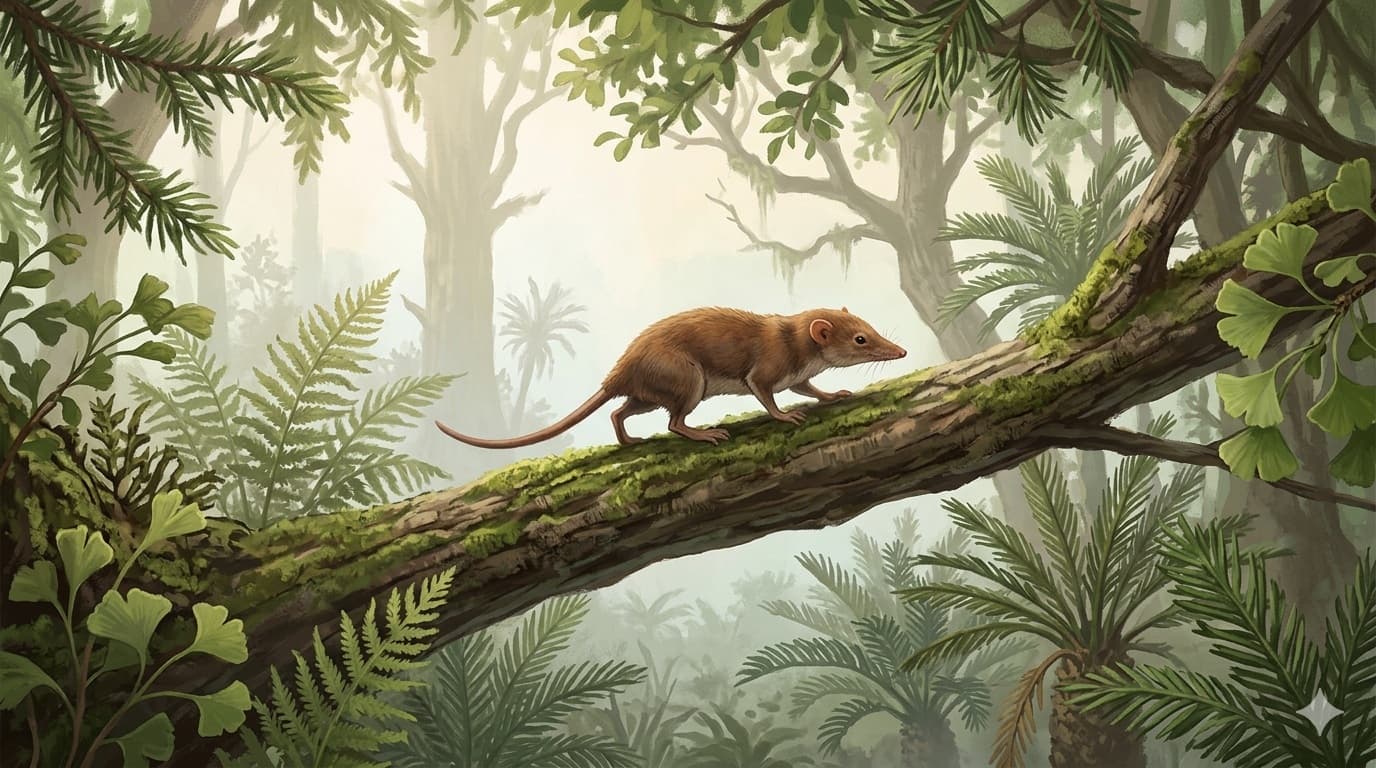
A tiny, shrew-like creature that represents one of the earliest known placental mammals — a pivotal branch point in the story of all eutherian life.
Overview
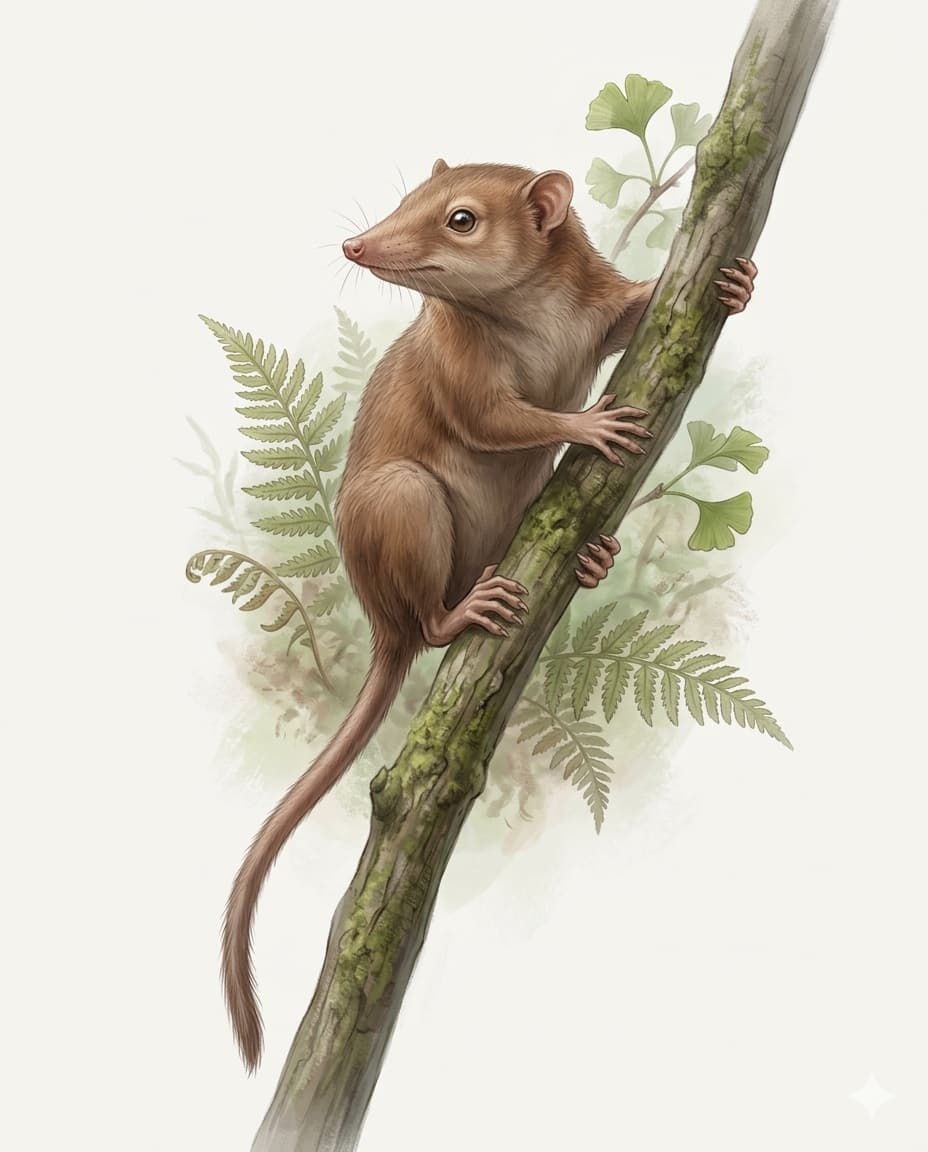
Juramaia sinensis — whose name translates roughly as 'Jurassic mother from China' — lived approximately 160 million years ago during the Late Jurassic period. Discovered in Liaoning Province, China, and formally described in 2011, this small insectivorous mammal has reshaped our understanding of when the eutherian (placental) mammal lineage diverged from its marsupial relatives. At roughly 15–17 grams, Juramaia was no larger than a modern shrew. Yet its fossilized remains, including an exquisitely preserved partial skeleton and skull, reveal specialized teeth and forelimb bones adapted for climbing and an insect-rich lifestyle in the Jurassic forest understory. Juramaia is not claimed to be a direct ancestor of humans. Rather, it represents the earliest currently known fossil evidence that the eutherian lineage — the branch of mammals that eventually gives rise to primates, rodents, elephants, whales, and ultimately humans — had already separated from the metatherian (marsupial) lineage by the Jurassic. In the long arc of evolution, Juramaia occupies a foundational chapter: it demonstrates that the biological groundwork for all placental mammals, including ourselves, was being laid more than 160 million years before modern humans walked the Earth.
Key Traits
- Estimated body mass of only 15–17 grams — roughly the size of a house shrew
- Dentition adapted for insectivory, with specialized molar cusp patterns seen in later eutherians
- Forelimb bones suggest arboreal (tree-climbing) capability
- Placental reproductive strategy — young developed further before birth compared to marsupials
- Warm-blooded with likely fur covering
- Nocturnal lifestyle inferred from small body size and ecological niche
Habitat
Juramaia lived in the lush, humid forests of what is now northeastern China during the Late Jurassic period. The environment was dominated by cycads, ferns, early flowering plants, and conifers beneath a warm, greenhouse climate. Volcanic activity was common in the region, and the fine-grained lake sediments of the Yixian Formation preserved Juramaia in exceptional detail.
Diet
Juramaia was an insectivore, feeding primarily on small invertebrates such as beetles, worms, and other insects. Its specialized molar teeth — with multiple cusps arranged in patterns seen in later eutherians — were well-suited for crushing the hard exoskeletons of insects. Fruit or small plant matter may have supplemented its diet.
Why This Stage Matters
Juramaia sinensis pushed back the known origin of eutherian mammals by approximately 35 million years compared to previous fossil evidence. This single discovery confirmed that the split between placental mammals and marsupials occurred no later than the Jurassic, resolving a long-standing debate about molecular versus fossil evidence for the timing of mammalian divergence. It also demonstrated that early eutherians were already ecologically diverse and anatomically sophisticated 160 million years ago — not simply undifferentiated 'proto-mammals' waiting for the dinosaurs to disappear.
Evolutionary Context
Juramaia lived alongside non-avian dinosaurs during the height of the Mesozoic Era. Small mammals like Juramaia occupied the shadow of the dinosaurs, filling ecological niches as nocturnal insectivores and climbers. The mass extinction event at the end of the Cretaceous (about 66 million years ago) that wiped out non-avian dinosaurs opened vast ecological opportunities for mammals — and the eutherian lineage established in part by ancestors related to Juramaia exploded in diversity during the Paleocene and Eocene epochs that followed. Over the next 100+ million years, eutherians would evolve into every major mammalian group alive today, including the primate lineage that eventually leads toward humans.
What Came Before & After
Next stage
Purgatorius
Early primate-like mammal

Key Sources
- Luo, Z.-X., Yuan, C.-X., Meng, Q.-J., & Ji, Q. (2011). A Jurassic eutherian mammal and divergence of marsupials and placentals. Nature, 476, 442–445.
- O'Leary, M. A., et al. (2013). The placental mammal ancestor and the post-K-Pg radiation of placentals. Science, 339, 662–667.
Want to learn more?
Ask Dr. Elena Marsh
Have a question about Juramaia sinensis or where it fits in the story of human evolution? Our AI expert is ready to help.
 Ask Dr. Elena Marsh