Deep Dive
Mammals in the Age of Dinosaurs
For over 100 million years, our tiny mammalian ancestors lived alongside dinosaurs. Discover their diverse ecological niches, nocturnal lifestyles, varied diets, and remarkable resilience. Learn how the end-Cretaceous mass extinction event opened the door for the mammalian radiation that eventually led to us.
Small but Mighty: Our Mesozoic Ancestors
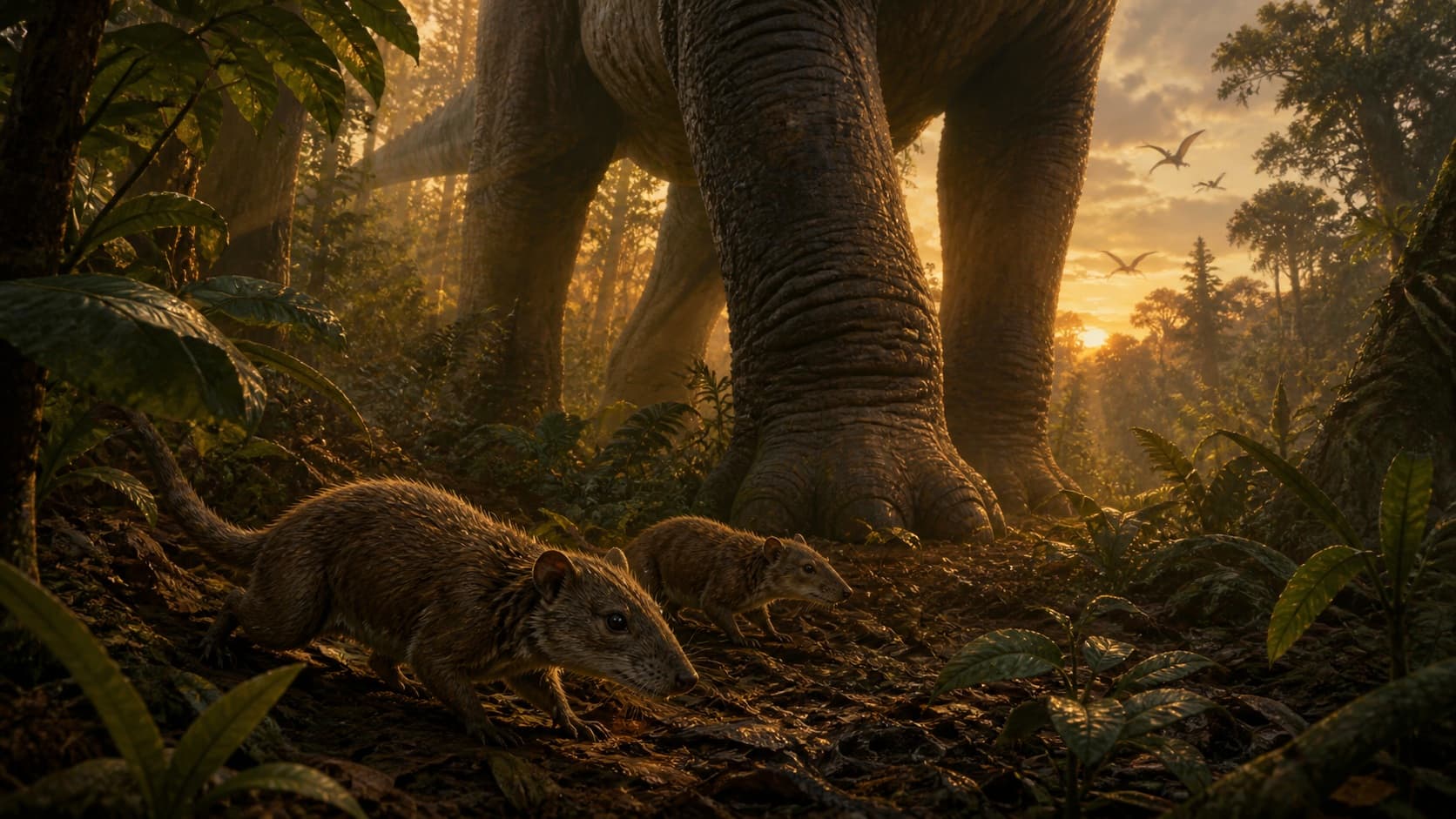
For most of their Mesozoic history, mammals were small — typically mouse to shrew-sized — constrained in body size by competition with dinosaurs. This was long interpreted as evidence of evolutionary stagnation: mammals simply waiting in the wings for their moment. Recent fossil discoveries have overturned this picture entirely.
Mesozoic mammals were ecologically diverse: Castorocauda lutrasimilis was an otter-like swimmer from the Jurassic; Volaticotherium antiquum was a gliding insectivore; Repenomamus robustus was a badger-sized predator that ate young dinosaurs. Far from ecological bit-players, early mammals occupied a remarkable variety of roles.
The Nocturnal Bottleneck
Despite this diversity, there is compelling evidence that the common ancestor of placental mammals passed through a 'nocturnal bottleneck' — a period during which mammals were predominantly active at night, when large dinosaurs were less active. This period left a lasting mark on mammalian biology.
Compared to most reptiles, mammals have enhanced hearing and smell, a reduction in the number of cone types in the eye (suggesting ancestors with reduced color vision in dim light), and the ability to generate their own body heat (essential for nighttime activity in cooler conditions). These traits may all be legacies of a Mesozoic night-shift.
Diverse Diets in a Dinosaur World
Fossil evidence shows Mesozoic mammals exploiting food sources ranging from insects and small vertebrates to plants, seeds, and fish. This dietary diversity was a key factor in their survival. Generalist feeders are better positioned to survive environmental disruptions than specialists — a lesson that would prove critical at the end of the Cretaceous.
The highly differentiated, precise teeth of mammals — which allowed them to process a wide range of foods efficiently — gave them a significant advantage over many other groups when ecosystems were disrupted.
The End-Cretaceous Extinction and the Mammalian Moment
Approximately 66 million years ago, an asteroid approximately 10 kilometers across struck what is now the Yucatan Peninsula in Mexico. The impact triggered global wildfires, blocked sunlight with ejecta and soot, and caused a catastrophic collapse of food chains. Three-quarters of all species on Earth went extinct, including all non-avian dinosaurs.
Mammals survived — likely due to their small size (lower food requirements), burrowing and hiding behaviors, dietary flexibility, and possibly faster reproductive rates. The extinction did not just allow mammals to survive; it cleared ecological space for an explosion of mammalian diversification known as the Paleogene radiation, which set the stage for every mammal alive today.

AI Assistant
Have a question? Ask Dr. Elena Marsh
Dr. Marsh is an AI-powered expert in human and mammalian evolution, ready to answer your questions about any topic covered on this site.