Deep Dive
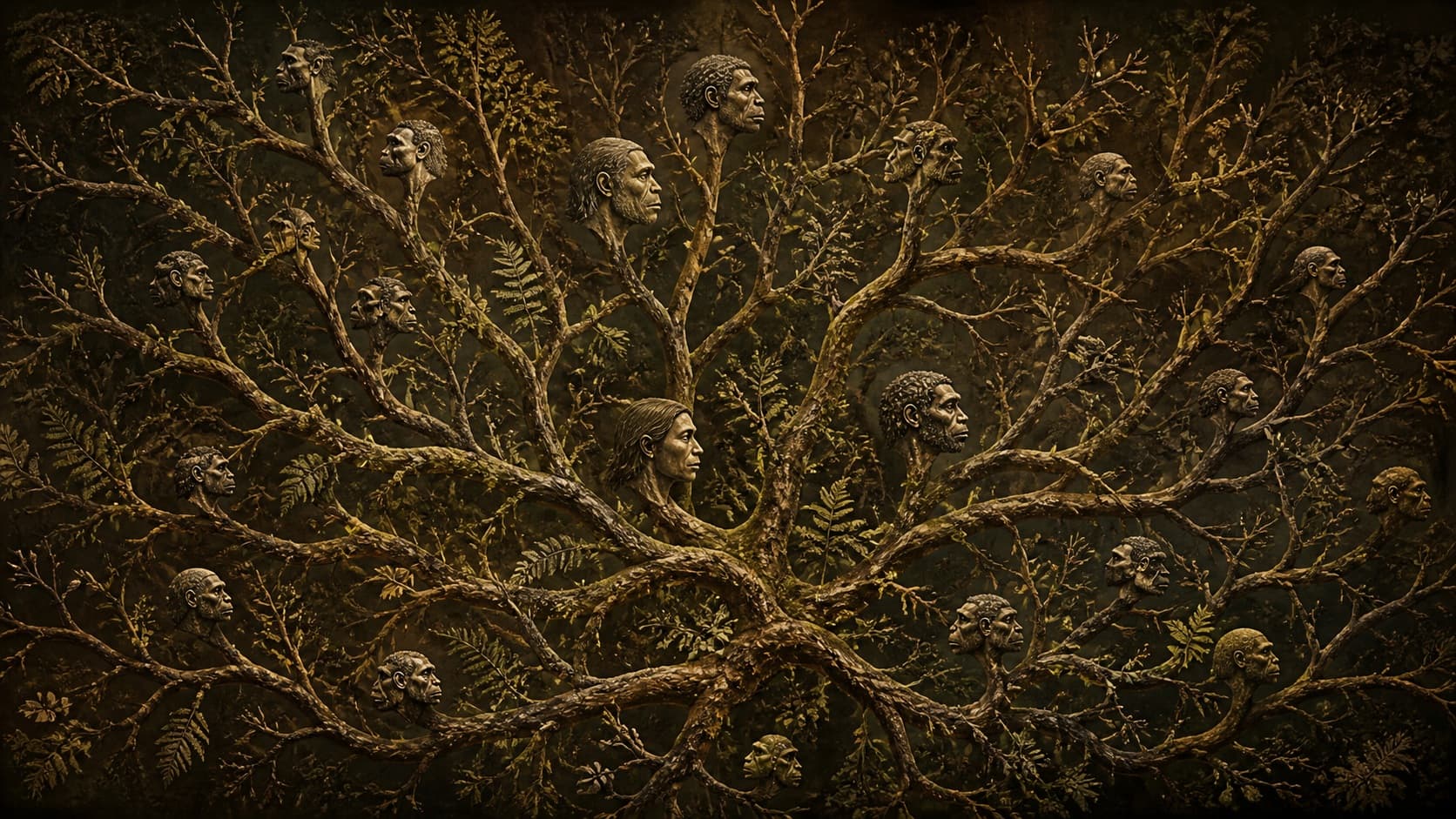
The Human Family Tree Is a Bush, Not a Ladder
Forget the outdated “ladder of progress” view of evolution. The story of human origins is a complex, branching bush filled with multiple hominin species, dead ends, interbreeding, and parallel experiments. Explore how our relatives like Neanderthals, Denisovans, and various Australopithecus and Homo species coexisted and contributed to modern human diversity.
The March of Progress Is Wrong
For decades, popular depictions of human evolution showed a neat parade: knuckle-dragging ape gradually straightening up into modern human. This 'March of Progress' image, first published in 1965, has proven remarkably difficult to dislodge despite being fundamentally misleading.
Evolution does not work toward a goal. There is no built-in direction, no inevitable endpoint. At any given moment in the Pliocene or Pleistocene, multiple hominin species were living simultaneously — competing, sometimes cooperating, occasionally interbreeding, and often going extinct with no descendants.
A Crowded Hominin World
Around 2 million years ago, at least three hominin species coexisted in East and South Africa: Homo habilis, Homo rudolfensis, and Paranthropus boisei. By 1 million years ago, Homo erectus had spread across Africa, Europe, and Asia — yet other Homo species continued to exist alongside it.
Even as recently as 40,000 years ago, Homo sapiens shared the planet with Neanderthals in Europe and the Middle East, Denisovans in Asia, and possibly Homo luzonensis in the Philippines. The idea that evolution moves in a single file, one species giving rise to the next, is contradicted by this crowded hominin record.
Interbreeding and Gene Flow
Ancient DNA analysis has transformed our understanding of human evolution. Modern humans outside Africa carry roughly 1–4% Neanderthal DNA — the result of interbreeding that occurred when Homo sapiens first expanded out of Africa. People from Southeast Asia and Oceania carry an additional 3–6% Denisovan DNA.
This means the boundaries between hominin 'species' were permeable. Homo sapiens, Neanderthals, and Denisovans were different enough to be classified separately, yet similar enough to produce fertile offspring. Our genome today is a mosaic shaped by encounters across tens of thousands of years.
Dead Ends and Surviving Branches
The vast majority of hominin branches ended in extinction. Paranthropus, with its massive jaw and grinding teeth adapted for tough plant matter, vanished around 1.2 million years ago. Homo floresiensis — a tiny, island-dwelling Homo species from Indonesia — survived until at least 50,000 years ago before disappearing.
Only one branch survived to the present: Homo sapiens. But our survival was not inevitable. We faced near-extinction ourselves, with genetic evidence suggesting our ancestral population may have dropped to just a few thousand individuals around 900,000 years ago — a bottleneck that shaped human genetic diversity worldwide.

AI Assistant
Have a question? Ask Dr. Elena Marsh
Dr. Marsh is an AI-powered expert in human and mammalian evolution, ready to answer your questions about any topic covered on this site.