Deep Dive
The Great Mammalian Radiation
After the dinosaurs vanished, mammals exploded in size, shape, and habitat. Trace the major branches of mammalian evolution—monotremes, marsupials, and placentals—and see how this diversification set the stage for the primate lineage that ultimately produced humans. A perfect bridge between deep time and our own story.
After the Asteroid: An Empty World
The end-Cretaceous mass extinction did not create an empty planet, but it created an ecologically simplified one. With large dinosaurs gone, the ecological niches they had occupied — large predator, large herbivore, flying vertebrate, and many others — were suddenly available. Mammals, birds, and other surviving lineages rushed to fill them.
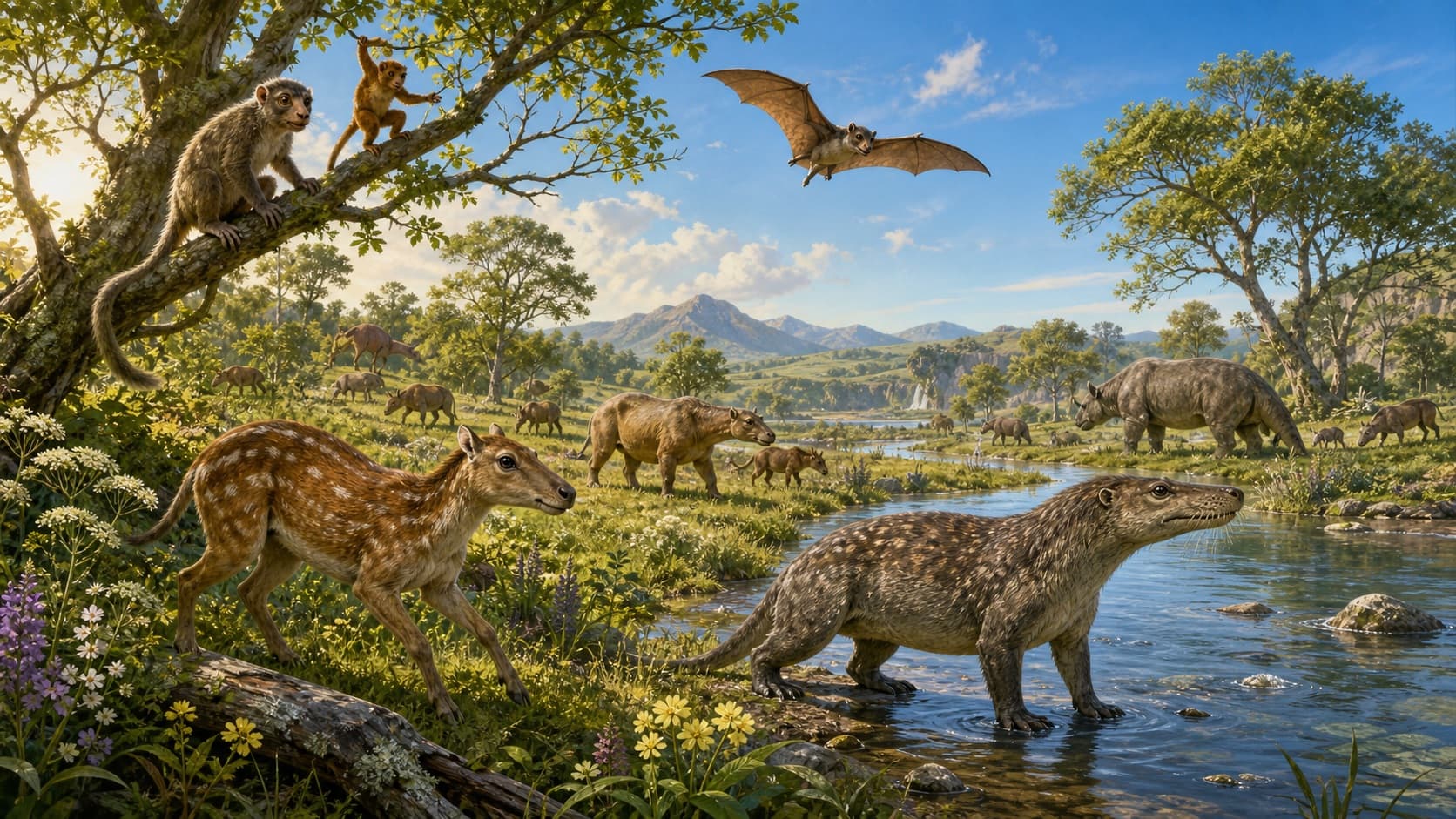
The rapidity of mammalian diversification after the extinction is striking. Within 10 million years of the asteroid impact, mammals had evolved into forms as diverse as early whales, large ground-dwelling herbivores the size of modern horses, and the earliest true primates. The pace of evolutionary change was faster than at almost any other time in mammalian history.
Three Branches: Monotremes, Marsupials, and Placentals
Living mammals are divided into three major groups. Monotremes (platypus and echidnas) are the most ancient branch; they lay eggs and retain several ancestral features. Marsupials (kangaroos, opossums, koalas, and their relatives) give birth to highly undeveloped young that complete development in an external pouch. Placentals — which include humans — nourish young through a placenta and give birth at a more advanced developmental stage.
These three groups diverged over 200 million years ago. By the Paleogene, placentals had diversified into the major orders we recognize today: rodents, bats, carnivores, ungulates (hoofed mammals), cetaceans (whales and dolphins), and primates — the order to which humans belong.
Remarkable Evolutionary Experiments
The mammalian radiation produced some of evolutionary history's most dramatic transformations. Pakicetus, a small land-dwelling mammal from 53 million years ago, was the ancestor of modern whales — one of the most complete sequences of major body-plan change in the fossil record. Within 15 million years, its descendants had fully returned to the sea.
Bats — the only mammals capable of true flight — appear in the fossil record already fully formed as bats by 52 million years ago, their rapid origin from small insectivorous mammals still not fully understood. The diversity of mammalian form, from the largest animal ever to have lived (the blue whale) to the tiny bumblebee bat, all traces back to the survivors of that end-Cretaceous night.
The Primate Lineage and the Road to Us
Primates — the order that includes lemurs, monkeys, apes, and humans — emerged during the Paleocene and Eocene, initially as small, tree-dwelling, insect-eating mammals. Their defining traits — grasping hands with nails rather than claws, forward-facing eyes providing stereoscopic depth perception, and enlarged brains relative to body size — were almost certainly adaptations to life in the forest canopy.
The great mammalian radiation that followed the dinosaur extinction was the necessary precondition for our own existence. Every stage on this site — from Juramaia sinensis to Homo sapiens — is a chapter in a story that begins with a world suddenly open to mammalian possibilities, 66 million years ago.

AI Assistant
Have a question? Ask Dr. Elena Marsh
Dr. Marsh is an AI-powered expert in human and mammalian evolution, ready to answer your questions about any topic covered on this site.