Deep Dive
Key Adaptations in Mammalian Evolution
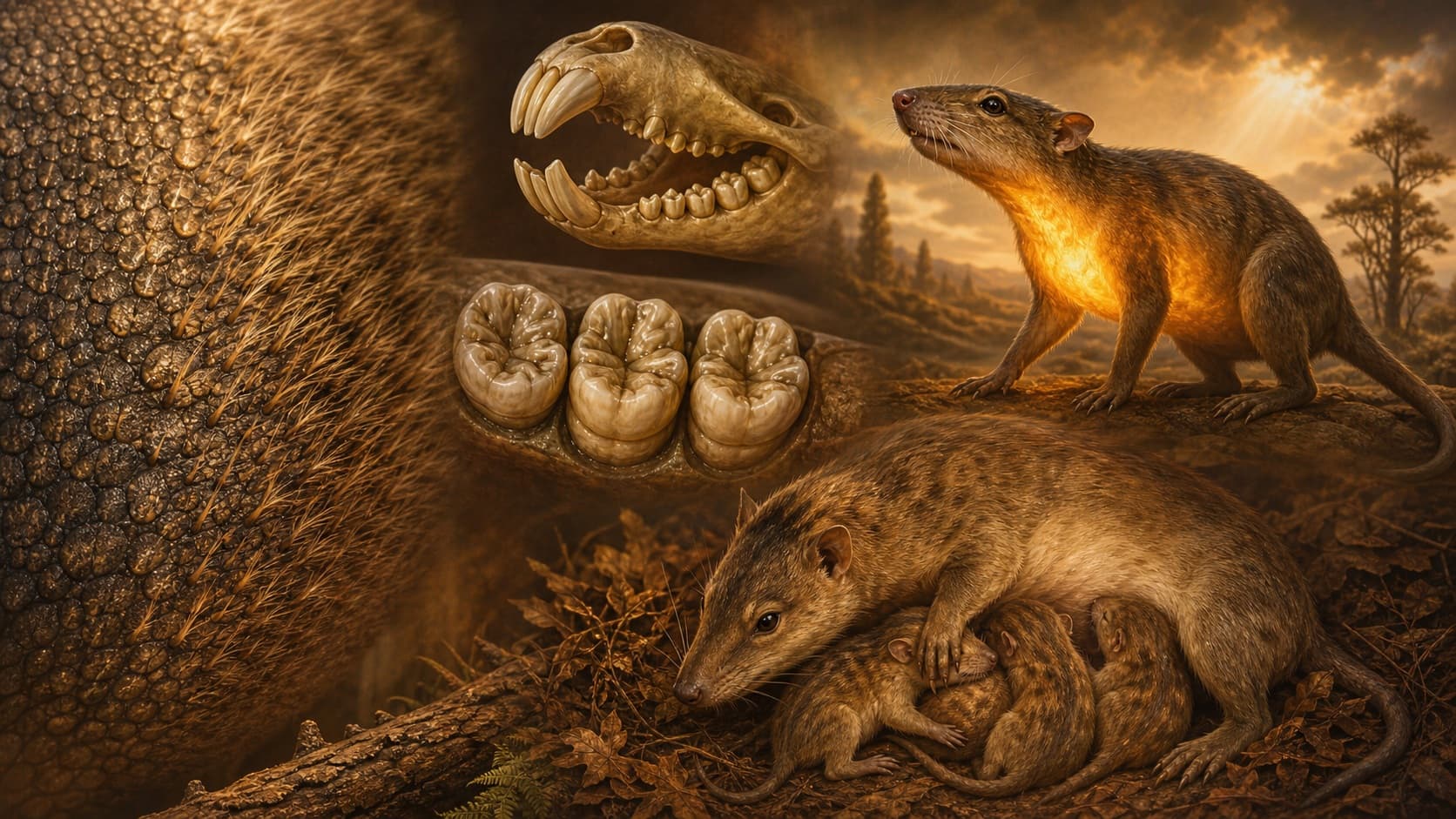
From the extinction of the dinosaurs to global dominance, what evolutionary innovations allowed mammals to thrive? Dive into the development of endothermy (warm-bloodedness), lactation, specialized teeth, enhanced senses, and brain power—and how these traits enabled our ancestors to survive and diversify over 160 million years.
Endothermy: The Warm-Blooded Advantage
Endothermy — the ability to generate body heat internally — is one of the most energetically expensive adaptations in the animal kingdom. A mammal at rest burns roughly 10 times more energy than a similarly sized reptile. Yet the advantages proved decisive: a stable internal temperature allows mammals to remain active in cold conditions, to occupy cold climates, and to maintain the high metabolic rates needed to fuel a large brain.
The evolutionary origin of endothermy is debated, but fossil evidence from cynodont synapsids suggests that some degree of internal heat generation predates the first true mammals. Hair, which provides insulation, likely evolved in concert with endothermy as an energy-saving mechanism.
Lactation and Extended Parental Investment
Lactation — feeding young with milk produced by the mother — is universal among mammals and unique to the class. It allows offspring to be born at an earlier developmental stage, with the mother's body providing nutrition externally during the vulnerable period of growth. This shifts the energetic burden from gestation to post-birth care, offering greater flexibility.
Extended parental investment, enabled by lactation, also allows for longer periods of learning and brain development. In humans and other primates, this period of dependency is remarkably long — years rather than weeks — and is linked to the development of complex social behavior and intelligence.
Specialized Teeth: Nature's Swiss Army Knife
Unlike most reptiles, which have simple, uniform teeth (homodonty), mammals evolved heterodont dentition — teeth of different shapes and functions. Incisors for cutting, canines for gripping, premolars for shearing, and molars for grinding allow a single animal to process a much wider range of foods.
Tooth morphology is also a remarkably reliable guide to diet and ecology in the fossil record, because enamel is the hardest substance in the body and preserves exceptionally well. Much of what we know about extinct mammals — including many stages on this site — is inferred from teeth alone.
The Expanding Mammalian Brain
Mammals have, on average, brains roughly 10 times larger relative to body size than non-avian reptiles. The neocortex — the outer layer of the cerebral cortex responsible for higher-order thinking, sensory processing, and voluntary movement — is a uniquely mammalian structure, and its expansion has been the dominant trend in primate and human evolution.
Brain expansion is metabolically costly; the human brain consumes roughly 20% of our resting energy despite comprising only 2% of body weight. The selective pressures that drove this expansion — complex social environments, tool use, language — are among the most studied questions in evolutionary biology.
Enhanced Senses: Hearing, Smell, and Touch
Mammals are distinguished from most other vertebrates by a dramatically enhanced sense of smell. The mammalian olfactory system is among the most sophisticated in the animal kingdom, with thousands of distinct olfactory receptor genes allowing fine-grained chemical discrimination. This was likely critical for our nocturnal Mesozoic ancestors, who relied on smell to navigate, find food, and detect predators in the dark.
Hearing was also transformed during mammalian evolution. The repurposing of two former jaw bones — the quadrate and articular — into the malleus and incus of the middle ear is one of evolution's most well-documented transitions. The result was a three-bone middle ear of extraordinary sensitivity, capable of detecting a far wider range of frequencies than the single-bone ear of reptiles. In many mammals, touch receptors associated with whiskers (vibrissae) provide additional high-resolution spatial information — another legacy of the Mesozoic night.

AI Assistant
Have a question? Ask Dr. Elena Marsh
Dr. Marsh is an AI-powered expert in human and mammalian evolution, ready to answer your questions about any topic covered on this site.