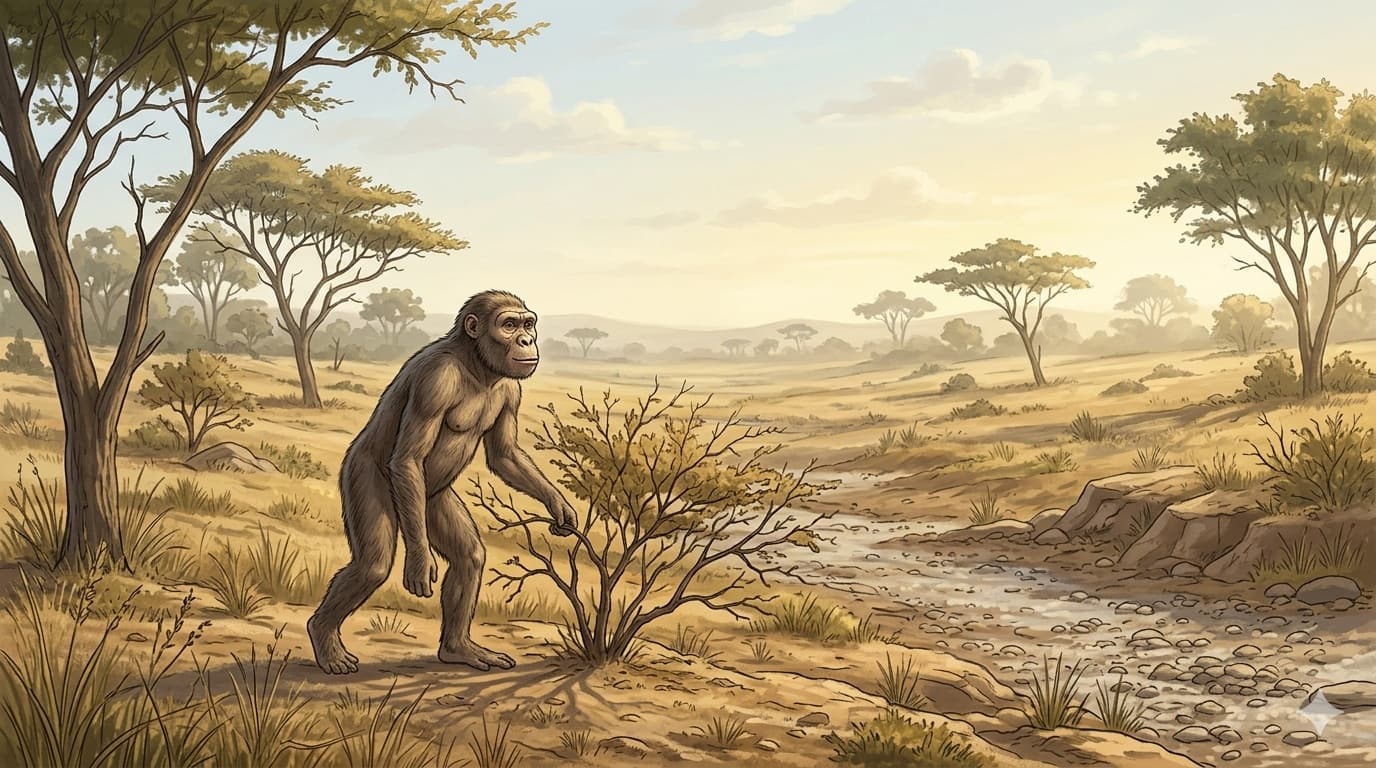
Sahelanthropus tchadensis
Very early hominin
About 7 to 6 million years ago
Miocene
Sahelanthropus tchadensis
Very early hominin
One of the oldest known potential hominins, discovered in Chad, showing a mix of ape-like and human-like features that places it near the crucial split between human and chimpanzee lineages.
Overview
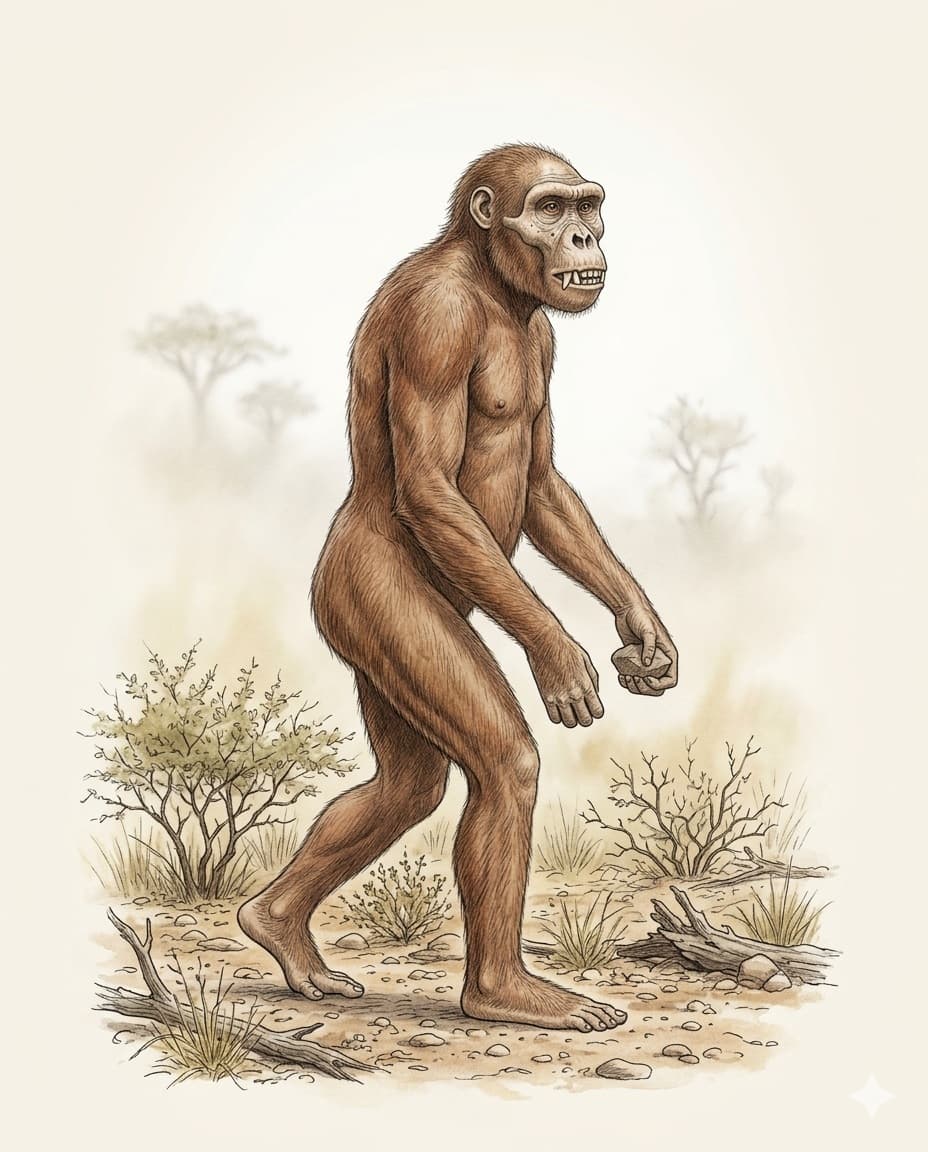
Sahelanthropus tchadensis is one of the most ancient and controversial figures in hominin paleontology. Discovered in the Djurab Desert of Chad in 2001 and described in 2002, this species lived approximately 6–7 million years ago — remarkably close to the estimated time when the human and chimpanzee lineages diverged. The most complete specimen, nicknamed 'Toumaï' (meaning 'hope of life' in the local Goran language), consists primarily of a nearly complete cranium that combines surprisingly human-like features — a flattened face, reduced canine teeth, and a foramen magnum position suggesting possible upright posture — with an ape-sized brain. Whether Sahelanthropus was actually bipedal and genuinely a hominin remains actively debated among scientists. It may represent a very early hominin, an early member of the chimpanzee lineage, or even a common ancestor of both. Regardless of its exact position, it provides remarkable evidence that the human-ape divergence was occurring in central Africa and that even the earliest candidates for the human lineage were already showing a mosaic of features.
Key Traits
- Brain size of approximately 340–360 cc — within chimpanzee range
- Relatively flat face compared to other great apes — a more human-like feature
- Reduced canine teeth compared to other Miocene apes
- Foramen magnum position may suggest upright posture, though this remains debated
- Thick brow ridges — a more ape-like feature
- Lived in a mosaic environment of forests, grasslands, and lake margins
Habitat
Sahelanthropus lived in what is now the Saharan region of Chad, which 6–7 million years ago was a very different landscape — a mosaic of forests, gallery woodlands, grasslands, and lake shores near a large ancient lake called Mega-Chad.
Diet
Likely omnivorous, consuming fruits, leaves, seeds, and possibly small animals or invertebrates, based on its dental morphology and the reconstructed palaeoenvironment.
Why This Stage Matters
Sahelanthropus tchadensis pushed the known record of potential hominins back to approximately 7 million years ago and demonstrated that early human relatives were present in central Africa — not just East Africa as previously assumed. Its combination of features has generated enormous scientific debate about the very definition of what makes a hominin.
Evolutionary Context
The period from roughly 8 to 5 million years ago is sometimes called the 'dark age' of hominin evolution because the fossil record is sparse. Sahelanthropus provides a rare window into this critical time. Its discovery, along with other early hominins like Orrorin tugenensis and Ardipithecus kadabba, suggests that the earliest hominins were already experimenting with upright posture and reduced canines — traits that would become central to the human lineage.
What Came Before & After


Key Sources
- Brunet, M., et al. (2002). A new hominid from the Upper Miocene of Chad, Central Africa. Nature, 418, 145–151.
- Zollikofer, C. P. E., et al. (2005). Virtual cranial reconstruction of Sahelanthropus tchadensis. Nature, 434, 755–759.
Want to learn more?
Ask Dr. Elena Marsh
Have a question about Sahelanthropus tchadensis or where it fits in the story of human evolution? Our AI expert is ready to help.
 Ask Dr. Elena Marsh