
Homo heidelbergensis
Archaic human
About 700,000 years ago
Pleistocene
Homo heidelbergensis
Archaic human
A large-brained archaic human that lived in Africa and Europe, likely ancestral to both Neanderthals and modern humans, showing evidence of advanced hunting and possible symbolic behavior.
Overview
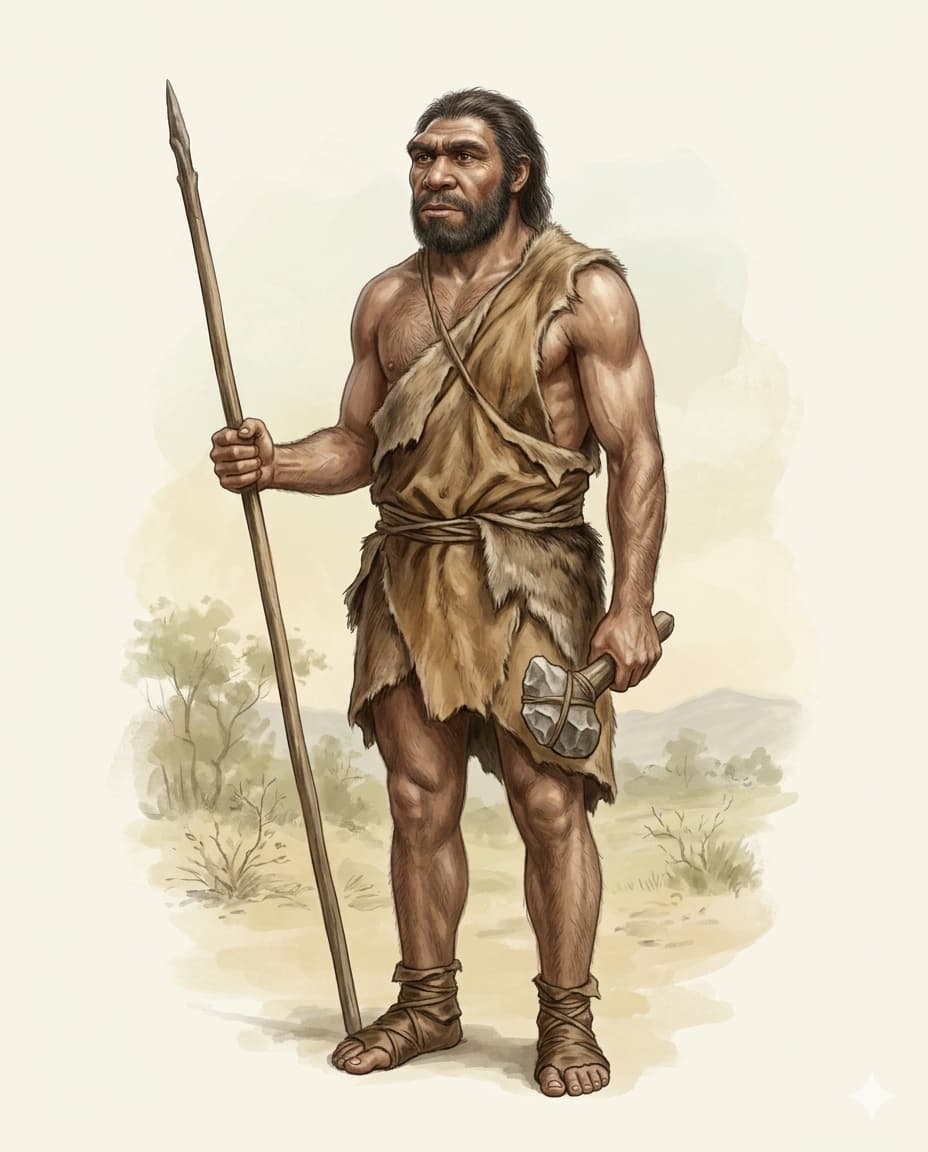
Homo heidelbergensis is an archaic human species that lived from approximately 700,000 to 200,000 years ago across Africa and Europe. With a brain size overlapping substantially with modern humans (averaging around 1200 cc), H. heidelbergensis represents a major step toward modern human cognition and behavior. Associated with Levallois and other advanced stone tool technologies, and with the earliest credible evidence of constructed wooden spears (the Schöningen spears, Germany, c. 300,000 years ago), this species was a sophisticated hunter. H. heidelbergensis is widely considered a common ancestor of both Neanderthals (in Europe and western Asia) and anatomically modern Homo sapiens (in Africa), though the exact phylogenetic picture is complicated by ongoing fossil and genetic discoveries including the mysterious Denisovans.
Key Traits
- Brain size averaging approximately 1200 cc — approaching modern human range
- Large, robust body build adapted for cold climates in some populations
- Associated with Levallois and Acheulean stone tool industries
- Evidence of systematic large-game hunting including extinct horses and rhinoceroses
- Possible use of wooden spears (Schöningen, Germany) — earliest wooden tools
- Some evidence for early symbolic or aesthetic behavior
Habitat
H. heidelbergensis occupied a range of environments in Africa and Europe, including temperate forests, grasslands, and river valleys. European populations faced increasingly cold glacial climates.
Diet
Active hunters of large game including horses, deer, bears, and rhinoceroses, as well as foragers of plant foods. Diet was highly varied and regionally specific.
Why This Stage Matters
Homo heidelbergensis bridges the gap between H. erectus and the more recent branches of human evolution — Neanderthals and modern humans. Its large brain, sophisticated tools, and hunting capabilities illustrate the dramatic cognitive and cultural evolution occurring in the Middle Pleistocene.
Evolutionary Context
H. heidelbergensis appears to have diverged from African H. erectus populations and spread into Europe, where it gave rise to Neanderthals. African populations of H. heidelbergensis are considered likely ancestors of modern Homo sapiens. The story of this period is being actively rewritten by ancient DNA evidence revealing unexpected interbreeding and population complexity.
What Came Before & After


Key Sources
- Rightmire, G. P. (1998). Human evolution in the Middle Pleistocene: The role of Homo heidelbergensis. Evolutionary Anthropology, 6, 218–227.
- Stringer, C. (2012). The status of Homo heidelbergensis (Schoetensack 1908). Evolutionary Anthropology, 21(3), 101–107.
Want to learn more?
Ask Dr. Elena Marsh
Have a question about Homo heidelbergensis or where it fits in the story of human evolution? Our AI expert is ready to help.
 Ask Dr. Elena Marsh