Aegyptopithecus zeuxis
Early catarrhine primate
About 30 million years ago
Oligocene
Aegyptopithecus zeuxis
Early catarrhine primate
An early catarrhine primate from Egypt that provides a critical window into the evolutionary stage before the divergence of Old World monkeys and apes.
Overview
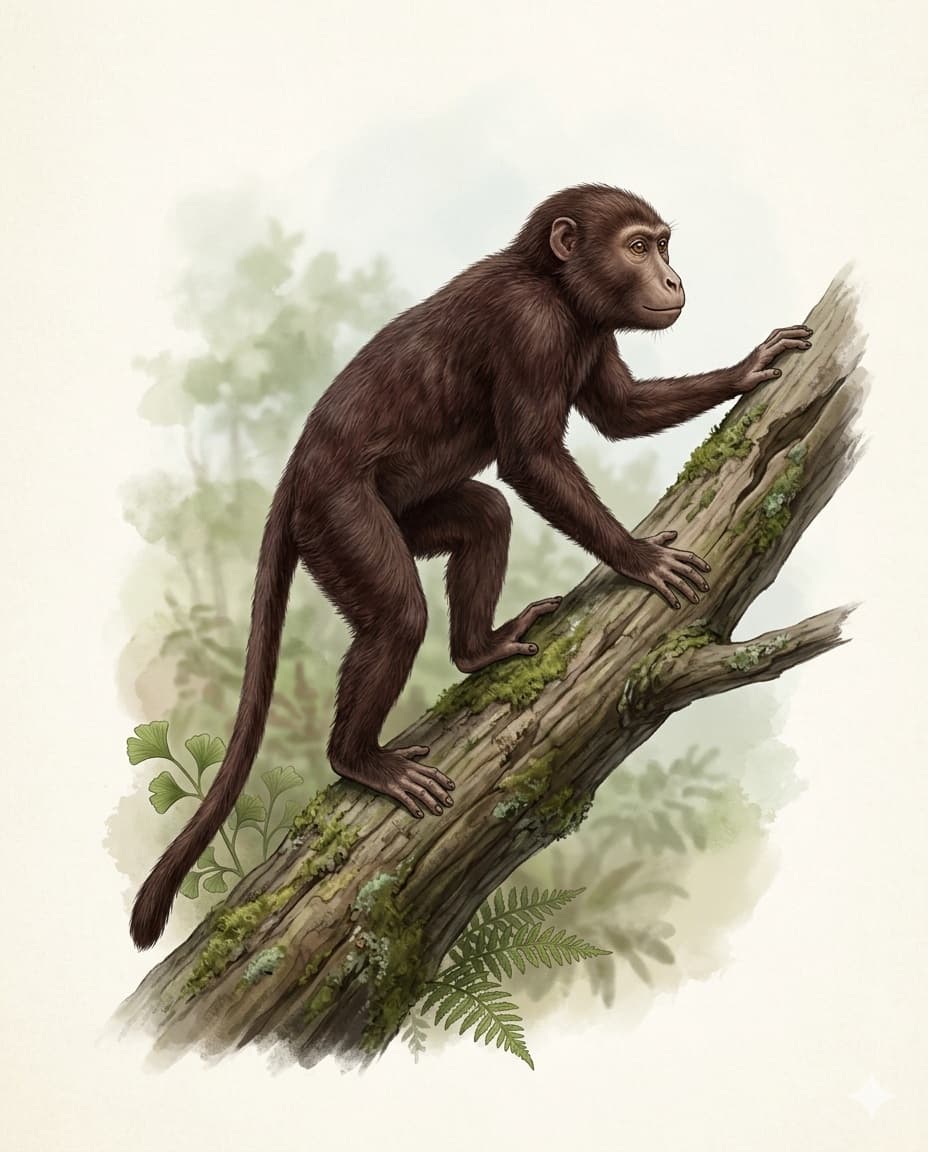
Aegyptopithecus zeuxis, meaning 'Egyptian linking ape,' lived approximately 30 million years ago in what is now the Fayum Depression of Egypt. It represents an important early catarrhine — the group that would eventually split into Old World monkeys and apes (including humans). About the size of a modern howler monkey, Aegyptopithecus had a relatively small brain but showed early dental and skeletal features that link it to later apes. It is not a direct human ancestor, but it illuminates a critical stage in primate evolution when the lineages leading to apes and Old World monkeys had not yet fully separated.
Key Traits
- Body size comparable to a modern howler monkey (approximately 6–8 kg)
- Dental formula and tooth structure consistent with early catarrhines
- Relatively small brain compared to later apes
- Forward-facing eyes providing good depth perception
- Sexually dimorphic canine teeth
- Arboreal lifestyle in a subtropical forest environment
Habitat
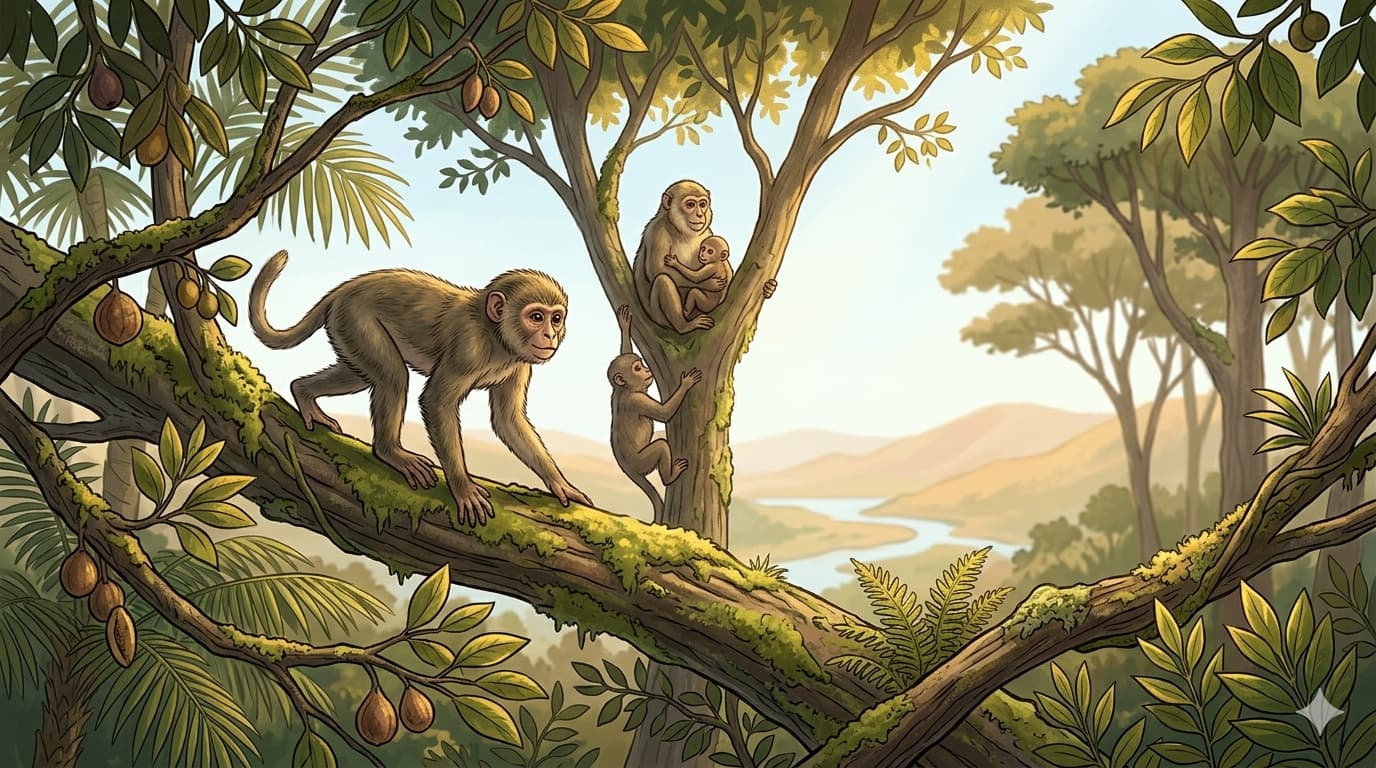
Aegyptopithecus lived in subtropical rainforests of northern Africa during the Oligocene epoch. The Fayum region, now desert, was once a lush, river-crossed landscape rich with fruiting trees and dense canopy.
Diet
Primarily frugivorous (fruit-eating), with leaves and other plant material supplementing its diet. Its large, low-crowned molars were well-suited for processing tough plant foods.
Why This Stage Matters
Aegyptopithecus zeuxis is one of the best-known Oligocene primates and provides key anatomical evidence for understanding the ancestor of all catarrhines — the group containing Old World monkeys, apes, and humans. It bridges the gap between earlier Eocene primates and the apes of the Miocene.
Evolutionary Context
By the Oligocene, the African continent was becoming an important center for primate evolution. Aegyptopithecus and its relatives were laying the anatomical groundwork for the great divergence between Old World monkeys and the ape lineage. Over millions of years following Aegyptopithecus, the ape lineage would evolve larger bodies, larger brains, and the loss of the tail that distinguishes true apes from monkeys.
What Came Before & After


Key Sources
- Simons, E. L. (1967). The earliest apes. Scientific American, 217(6), 28–35.
- Fleagle, J. G. (2013). Primate Adaptation and Evolution, 3rd ed. Academic Press.
Want to learn more?
Ask Dr. Elena Marsh
Have a question about Aegyptopithecus zeuxis or where it fits in the story of human evolution? Our AI expert is ready to help.
 Ask Dr. Elena Marsh